News Detail
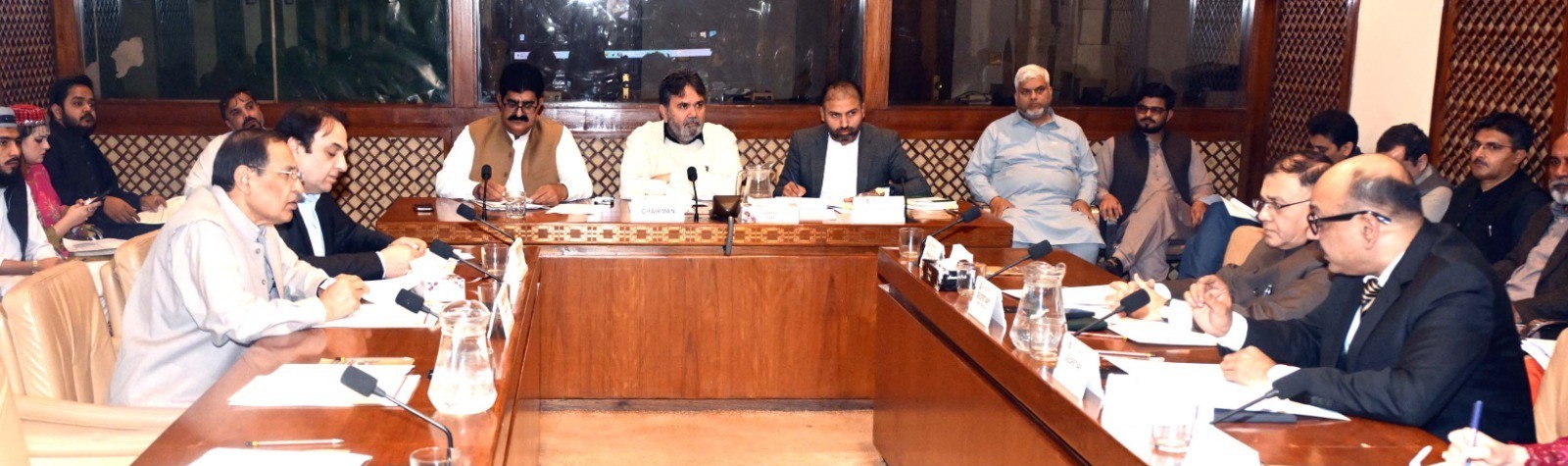
Event Title: Senator Rana Mahmood Ul Hassan, Chairman Senate Standing Committee on Cabinet Secretariat presiding over a meeting of the committee at Parliament House Islamabad
Event Date: 2026-11-18
Senate Standing Committee on Cabinet Secretariat Reviews Balochistan Job Quota, Khyber Pakhtunkhwa Transfers, Banking Compliance and Dual Nationality of Civil Servants
A meeting of the Senate Standing Committee on Cabinet Secretariat was held at Parliament House under the chairmanship of Senator Rana Mahmood ul Hassan. Senator Mohammad Abdul Qadir, Senator Dilawar Khan and other members of the Committee attended the meeting. Senator Amir Waliuddin Chishti and Senator Atta ur Rehman also participated through Zoom. Secretary Cabinet Division Kamran Ali Afzal, Secretary Establishment Division Barrister Nabeel Ahmad Awan, Chairman (NAMLCFTA) Mushtaq Ahmed Sukhera, MD PPRA Hasnat Qureshi and senior officials of the Establishment Division, Cabinet Division and other relevant departments were also present.
The Committee discussed several important matters, including employment opportunities and quota allocation for Balochistan, transfers of officers in Khyber Pakhtunkhwa, money laundering and compliance with Know Your Customer (KYC) requirements in banks, and dual nationality of civil servants.
Senator Mohammad Abdul Qadir emphasized the need to enhance employment opportunities for the youth of Balochistan in federal government institutions. He proposed a special five-to-ten-year employment package to ensure greater representation of the province in federal services, including the Police Service, Customs and other institutions. He observed that increased representation would promote inclusion, strengthen public confidence and provide talented youth with equal opportunities to contribute to national development.
Responding to the proposal, Secretary Establishment Barrister Nabeel Ahmad Awan stated that the proposal was under consideration and enjoyed considerable public support. He informed the Committee that an adjustment in the existing provincial quota, including the possibility of reallocating one per cent from Khyber Pakhtunkhwa and Sindh to Balochistan, was being examined. He assured the Committee that the recommendations would be considered at the appropriate level, including consultation with the concerned Minister and the Prime Minister's Office, if required.
However, he pointed out that the existing quota allocated to Balochistan in the CSS examination was also not being fully utilized due to an insufficient number of qualifying candidates. He offered to provide comprehensive data regarding vacant seats under the provincial quota over the past several years. He further highlighted the need to improve educational opportunities and competitive examination preparedness among students from Balochistan.
The Secretary Establishment also informed the Committee about a special employment initiative for Balochistan, under which 12,000 employment opportunities had been allocated. Of these, 5,500 positions were earmarked for the southern districts of the province, while recruitment against federal government positions was already underway. The remaining opportunities were to be facilitated through provincial stakeholders, including oil, gas and other relevant companies, with directions to prioritize local candidates. He observed that effective implementation of the ongoing employment initiative was equally important alongside any proposed revision of the quota.
Senator Dilawar Khan highlighted the security challenges and administrative difficulties faced by Khyber Pakhtunkhwa and Balochistan. He expressed concern over the shortage of senior police officers in Khyber Pakhtunkhwa, particularly at the DIG level, and questioned the transfer of three officers from Swabi, Charsadda and Haripur.
He emphasized that the prevailing security situation and ground realities of the province must be taken into account while making administrative decisions. He called for a review of the Hard Area Policy and urged the concerned authorities to reconsider the transfers in the larger public and administrative interest.
The Chairman, Senator Rana Mahmood ul Hassan, expressed serious concern over alleged money laundering activities and weaknesses in banking compliance mechanisms. He highlighted instances of suspicious financial transactions and questioned how substantial amounts could be deposited in accounts without adequate verification of the account holders' financial profiles and sources of income.
He stressed the need for effective implementation of anti-money laundering regulations, strict monitoring of suspicious transactions and accountability of bank officials where negligence or deliberate facilitation was established. He also raised concerns regarding the misuse of mobile numbers and SIM cards during the opening and operation of bank accounts and called for improved verification mechanisms in coordination with the relevant authorities.
Senator Dilawar Khan observed that anti-money laundering laws and regulatory requirements should not result in unnecessary harassment of legitimate taxpayers and registered businesses. He emphasized the need for a balanced approach that distinguishes between genuine commercial transactions and suspicious financial activities, while ensuring that enforcement measures are applied fairly and transparently.
The Chairman sought detailed clarification from the concerned authorities on three key matters: the measures taken to address money laundering involving bank officials or third parties; the challenges in holding bank employees accountable where KYC requirements are deliberately ignored or inadequately implemented; and the reforms introduced to strengthen institutional oversight, penalties and compliance standards to prevent financial crimes involving banking personnel.
The Chairman stated that the Committee would seek further clarification from the State Bank of Pakistan and, if necessary, summon its Governor to brief the Committee on the matter. He also indicated that the issue could be taken up jointly with the Finance Committee, where appropriate.
The Committee also discussed the issue of dual nationality among civil servants. Secretary Cabinet Kamran Ali Afzal informed the Committee that the matter had previously been examined and that the Establishment Division had introduced proposed rules requiring civil servants to obtain prior government permission before applying for foreign nationality.
He observed that while administrative rules could regulate the process, comprehensive legislation was required to establish a clear legal framework restricting dual nationality among civil servants. He suggested that any exception, particularly in cases of citizenship acquired by birth, should be specifically addressed through legislation.
The Chairman, Senator Rana Mahmood ul Hassan, emphasized the need for a clear and comprehensive policy on the matter. He also raised concerns regarding the acquisition of foreign permanent residency and citizenship through investment schemes and called for scrutiny of relevant cases, including allegations of irregularities involving certain officials.
Concluding the discussion, the Committee directed the concerned departments to submit comprehensive information and updated progress reports at its next meeting regarding Balochistan's employment quota and vacant positions, implementation of the special employment initiative, transfers of officers in Khyber Pakhtunkhwa, banking compliance and KYC mechanisms, and the proposed legal framework concerning dual nationality of civil servants.
The Committee emphasized the importance of effective implementation of policies, institutional accountability and equitable opportunities for all provinces.
The agenda on PPRA was deferred and will be discussed in the next meeting.