News Detail
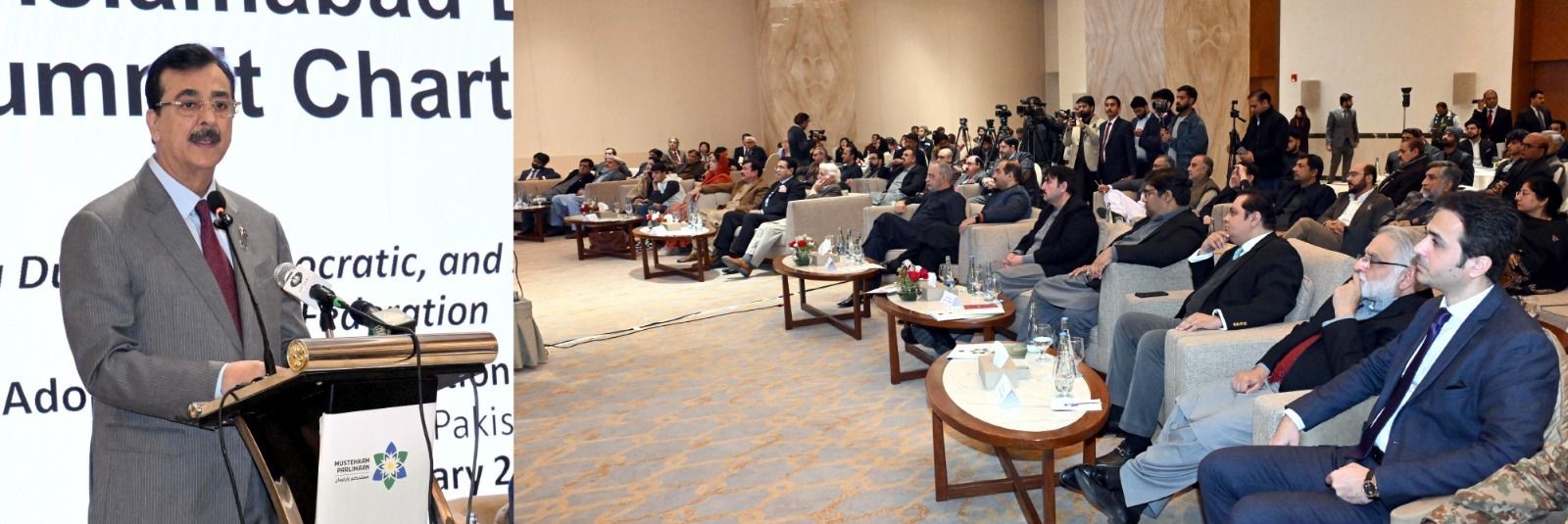
Event Title: Acting President Syed Yousaf Raza Gilani Addressing the Closing Ceremony of The Devolution Summit 2026 in Islamabad
Event Date: 2026-01-14
Chairman Senate, Syed Yousaf Raza Gilani, has emphasized that devolution must be examined as a constitutional system supported by law, fiscal resources, and capable institutions, rather than as a political slogan. He underlined the Senate’s constitutional role in safeguarding provincial rights, preserving the federal balance, and ensuring cooperative federalism as envisaged in the Constitution.
He expressed these views as Chief Guest at the closing ceremony of the Devolution Summit 2026. Syed Yousaf Raza Gilani reaffirmed Pakistan’s constitutional commitment to durable, functional, and citizen-centred devolution and stressing that decentralisation is a constitutional obligation, not a political option.
Welcoming the participants, the Chairman Senate appreciated Malik Muhammad Ahmad Khan, Speaker of the Provincial Assembly of Punjab, and Honourable Ahmad Iqbal Chaudhry, Convener Punjab Local Government Caucus, for convening the Summit. He noted that the two-day forum brought together parliamentarians, constitutional experts, public administrators, economists, and civil society representatives to engage in serious and structured deliberations on strengthening devolution in Pakistan.
Recalling his tenure as Prime Minister, Syed Yousaf Raza Gilani highlighted the Eighteenth Constitutional Amendment as a landmark achievement that restored parliamentary supremacy, strengthened provincial autonomy, and constitutionally entrenched decentralisation. He noted that the abolition of the Concurrent Legislative List and the transfer of key subjects education, health, agriculture, labour, and social welfare—to the provinces fundamentally rebalanced the federation. He further recalled the phased transfer of seventeen federal ministries and the observance of 1st July 2011 as Provincial Autonomy Day, symbolizing the shift towards constitutionally grounded shared governance.
The Chairman Senate also highlighted the role of the Implementation Commission constituted under Article 270AA, which supervised and coordinated the transfer of subjects and institutions from the federation to the provinces. He observed that the Commission’s work demonstrated that devolution is a continuous constitutional process requiring sustained political ownership, administrative readiness, and intergovernmental cooperation.
Emphasizing the fiscal dimension of devolution, he termed the Seventh National Finance Commission (NFC) Award an essential complement to the Eighteenth Amendment. By revising vertical and horizontal resource distribution and enhancing the provincial share in federal revenues, the Award aligned responsibilities with resources—an enduring pillar of effective federalism.
Referring to the Summit’s deliberations, the Chairman Senate observed that devolution in Pakistan has often remained cyclical rather than durable. He stressed the need for constitutional fidelity, continuity, and respect for institutional boundaries, cautioning against the dilution or reversal of constitutionally mandated decentralisation. In this context, he highlighted the establishment of the Senate Committee on Devolution, tasked with overseeing post-Eighteenth Amendment implementation, identifying institutional and legal bottlenecks, and engaging with federal and provincial governments to uphold constitutional balance.
Addressing fiscal devolution challenges, he noted persistent weaknesses where resources do not consistently follow devolved functions. He underscored the need for predictable, rule-based fiscal arrangements, stronger intergovernmental coordination, and enhanced financial authority at the sub-provincial level to improve accountability and service delivery.
On administrative reforms, the Chairman Senate pointed to the mismatch between a three-tier constitutional structure and a bureaucracy designed for a centralised state. He stressed that civil service structures, incentives, and career pathways must be aligned with decentralised governance while maintaining administrative coherence and accountability.
Highlighting the importance of grassroots democracy, Syed Yousaf Raza Gilani stated that local governments are the most visible and immediate expression of the state. He called for strengthening local government institutions, ensuring regular local elections, and clearly defining their powers and financial resources to realise the constitutional promise of devolution.
The Chairman Senate welcomed the Islamabad Devolution Summit Charter, describing it as a practical and thoughtful roadmap translating debate into constitutional, fiscal, and administrative principles. He stressed that its true value lies in sustained advocacy and implementation through legislative and executive action.
Reaffirming the Senate’s role, he stated that the Upper House will continue to serve as a forum for dialogue among federating units, a guardian of constitutional balance, and a catalyst for reforms that bring governance closer to the people. He emphasised that devolution strengthens national cohesion, deepens democratic participation, addresses grievances early, and builds public trust in institutions.
In his concluding remarks, the Chairman Senate expressed appreciation to the organisers, participants, and experts for the successful conduct of the Summit and expressed hope that the Islamabad Devolution Charter would remain a living document guiding policy and legislation in the national interest.