Economic Affairs
Senate of Pakistan
News Detail
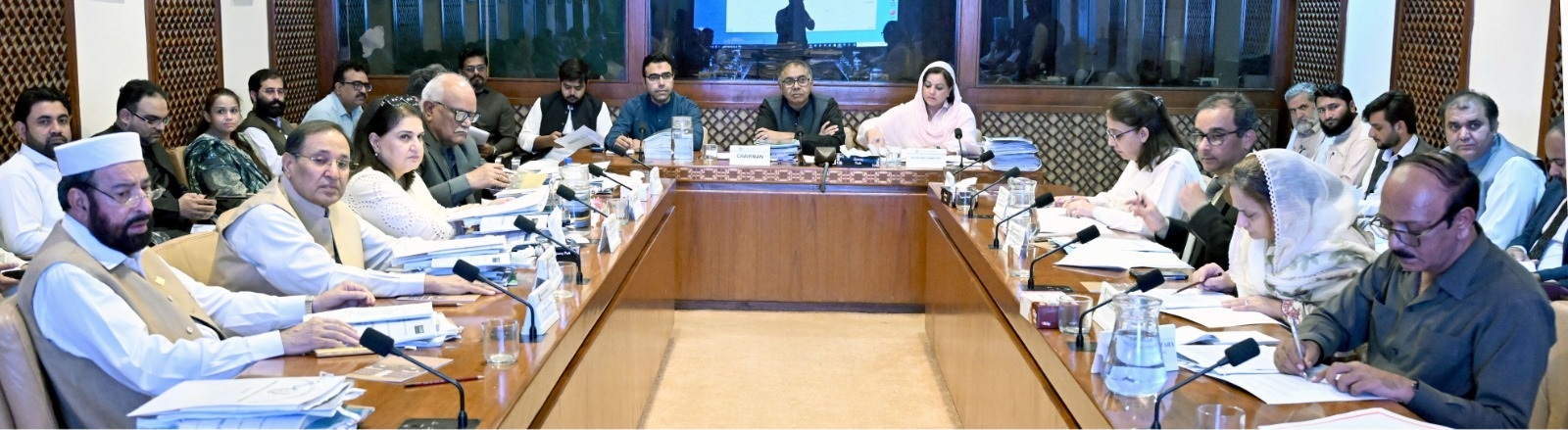
Press Release Title: Senator Saifullah Abro, Chairman Senate Standing Committee on Economic Affairs presiding over a meeting of the committee at Parliament House Islamabad
Press Release Date: 17th July, 2026
The Senate Panel found irregularities in Khyber Pakhtunkhwa's Foreign-Funding Communication Projects. ISLAMABAD - The Senate Standing Committee on Economic Affairs, chaired by Senator Saifullah Abro, held a detailed meeting to review the implementation, progress and utilisation of foreign-funded development projects across the country, with a special focus on Khyber Pakhtunkhwa's road, flood rehabilitation and Irrigation sector schemes. The committee received a comprehensive briefing from the Communication and Works Department, Government of Khyber Pakhtunkhwa, on district road projects, flood rehabilitation initiatives, externally funded infrastructure schemes and Irrigation sector projects financed by international development partners. At the outset, the committee sought a clear bifurcation between grants and loans received under foreign-funded development programmes and stressed the need for complete transparency regarding the utilisation of external financing. During the briefing on flood rehabilitation projects, committee members questioned the criteria adopted for selecting road schemes in flood-affected districts. Members observed significant disparities between the actual flood-hit areas and the allocation of reconstruction projects. The committee reviewed the list of completed and ongoing road projects and noted that the highest number of roads had been constructed in Mardan despite the district not being among the worst flood-affected areas. In contrast, severely affected districts including Upper Dir, Lower Dir and Chitral received comparatively fewer road projects. Senator Rubina Khalid pointed out that the maximum number of 16 roads had been constructed in Mardan, while only 12 kilometres of roads were built in Dir despite the district suffering extensive flood damage. Committee members questioned the basis on which roads were selected for construction across Khyber Pakhtunkhwa. Senator Hidayatullah observed that nine roads had been built in Peshawar despite the city not experiencing flood damage and sought details of the criteria used for project selection. Senator Rubina Khalid lamented that there was a clear disparity in project implementation, stating that reconstruction work had not been carried out where flood rehabilitation was genuinely required, while projects had been executed in areas where there was little or no need. She remarked that such inequitable allocation of development projects hindered balanced regional development. The committee also expressed concern that donor agencies may have been misled regarding project priorities. Members observed that deserving areas remained deprived of reconstruction while projects were shifted elsewhere under the pretext of donor requirements. Senator Waqar Mehdi noted that the same concerns also applied to foreign-funded development schemes. Officials of the Ministry of Economic Affairs informed the committee that once foreign loans are approved and transferred to provinces, ownership and implementation become the responsibility of the respective provincial governments. The ministry stated that it continues to facilitate loan disbursement and assists provinces in resolving bottlenecks whenever required. Chairman Committee Senator Saifullah Abro said it was unfortunate that Pakistan continued to accumulate external debt while resources were not being utilised where they were actually needed. He observed that the country's debt burden continued to rise every year while delays in project completion and poor utilisation further aggravated the financial situation. During the briefing, officials informed the committee that work on district road projects across Khyber Pakhtunkhwa was progressing rapidly, with the completion rate of most development schemes reaching 100 percent. The committee was informed that road projects had been completed in several districts, including Swat, Peshawar, Mardan and Nowshera. Work on 63 district road projects across the province was nearing completion, while the total length of district roads had reached approximately 488 kilometres. Officials said more than Rs10.9 billion had been spent on the construction and rehabilitation of district roads, adding that improved road infrastructure would significantly enhance travel facilities and connectivity for the public. The committee reiterated that whenever provinces receive grants or loans, mechanisms should be in place to ensure that the funds are utilised strictly for their intended purposes. Senator Hidayatullah said if a province receives a grant or loan, authorities must ensure that the money is spent on the same purpose for which it was obtained. Officials from the Ministry of Economic Affairs responded that once a province obtains a loan, responsibility for its utilisation rests with the provincial government, while the ministry continues to provide technical advice and facilitation whenever needed. Chairman Committee Senator Saifullah Abro said that if a province receives a loan, the people of that province have the first right over its proper utilisation. He stressed that authorities must also ensure that borrowed funds are spent for their approved objectives. Expressing concern over regional disparities, Senator Saifullah Abro remarked that injustice continued in Balochistan where roads were reconstructed every year despite other deserving areas requiring greater attention. Highlighting the country's growing debt burden, the Chairman informed the committee that Pakistan's national debt had increased from Rs40 trillion in 2022 to approximately Rs90 trillion at present. He warned that the rapidly increasing debt would create serious economic challenges for the country. "The loan has to be repaid; otherwise the country will have to be mortgaged," Chairman Committee Senator Saifullah Abro remarked. Senator Kamil Ali Agha stressed that future infrastructure planning must take changing climatic conditions into account, stating that storm water drainage systems should be designed according to emerging climate realities. During discussion on project costs, Senator Waqar Mehdi sought details of the cost of constructing one kilometre of road. KP officials informed the committee that one kilometre of road costs approximately Rs70 million to construct. Officials further stated that the province had constructed 770 kilometres of roads at a total cost of Rs69 billion. Questioning the financial details, Chairman Committee Senator Saifullah Abro asked why an additional Rs. 43 billion had been included despite the reported project cost of Rs69 billion. KP officials explained that the additional expenditure also covered the construction of several bridges associated with the road projects. The Chairman also questioned the award of contracts, observing that although several large construction companies operate in Khyber Pakhtunkhwa, work had been distributed among only two or three firms. Officials replied that other companies had not participated in the bidding process. Chairman Committee Senator Saifullah Abro remarked that this suggested open competitive bidding had not been properly conducted and directed officials to provide complete details of the Notice Inviting Tender (NIT). During a separate briefing on the Khyber Pakhtunkhwa Road Rehabilitation and Upgradation Project, officials informed the committee that the agreement with the Asian Development Bank (ADB) had been signed in 2018. The committee was informed that rehabilitation and upgradation of 249.5 kilometres of roads had been completed under the project. Officials said all 10 road projects under the KP Provincial Roads Project had been completed and opened for traffic. The total expenditure on the project stood at $146.2 million, while the loan closing date has been fixed for October 2026. Officials further informed the committee that all schemes had been completed ahead of schedule and achieved 100 percent physical progress. Completed highways include Kalam-Matiltan-Mahodand Road, Shah Alam-Sardar Yab Road, Risalpur-Jahangira Road and Haripur-Hattar-Taxila Road. The committee also received a detailed briefing on externally financed water sector projects in Khyber Pakhtunkhwa. Officials informed members that projects worth $387 million were being implemented with financial assistance from the Asian Development Bank, while additional projects worth $295 million were underway with World Bank financing. The committee was informed that the ADB-supported Flood Emergency Rehabilitation Project was currently under implementation with an overall completion target of June 2027. Officials stated that the total cost of the project was Rs15 billion, of which approximately Rs12.98 billion had already been spent. The project covers Malakand, Swat, Charsadda, Nowshera, Peshawar, Dir, Chitral and Dera Ismail Khan. The committee was informed that work was currently underway on 143 irrigation, drainage and flood protection schemes under the project. For the financial year 2025-26, Rs7.24 billion has been allocated, while Rs6.17 billion has already been utilised. Officials further informed the committee that 79 irrigation and drainage schemes had been completed, while the project also includes 64 flood protection schemes. The committee also discussed concerns regarding alleged unauthorised pressure by the World Bank's local representative on the Sindh Water and Agriculture Transmission Project. Chairman Committee Senator Saifullah Abro questioned the role of the World Bank's local representative, stating that the lender could either approve or decline financing but could not dictate how projects should be implemented. He said there was no clause allowing the World Bank to negotiate implementation matters, adding that project execution remained the sole responsibility of local authorities while the lender's role was limited to financing and loan recovery. The Chairman observed that unnecessary external pressure was increasing project costs and questioned how the World Bank could influence implementation decisions. During the discussion, officials informed the committee that the project cost had doubled. Senator Saifullah Abro stated that Pakistan should not succumb to external pressure, saying that Sindh could save approximately Rs14 billion by resisting unnecessary project changes. Referring to the Peshawar-Torkham project, the Chairman said similar pressure had previously been exerted regarding an amount of $890 million, adding that the committee had intervened and prevented unnecessary financial implications. He further stated that if the relevant authorities formally approached the World Bank, the local representative could be replaced. The Chairman directed the Economic Affairs Division to convene a meeting with the World Bank to address the matter and ensure that implementation of development projects remains within the authority of Pakistani institutions. The meeting was attended by Senator Rana Mahmood ul Hassan, Senator Rubina Khalid, Senator Haji Hidayatullah Khan, Senator Kamil Ali Agha, Senator Dilawar Khan and Senator Talha Mahmmod along with senior officials of relevant departments.